
 16TH-CENTURY BOOKS
16TH-CENTURY BOOKS
16TH-CENTURY BOOKS
 Royal
Household Affairs
Royal
Household Affairs  Partial
Payment for
Her Majesty's
Partial
Payment for
Her Majesty's Tapestry
 Isabel
I, Queen of Spain.
Document on paper, in Spanish, signed "Yo la Reyna." Granada,
8 May 1501. Folio (31.2 cm, 12.25"). [1] p.
Isabel
I, Queen of Spain.
Document on paper, in Spanish, signed "Yo la Reyna." Granada,
8 May 1501. Folio (31.2 cm, 12.25"). [1] p.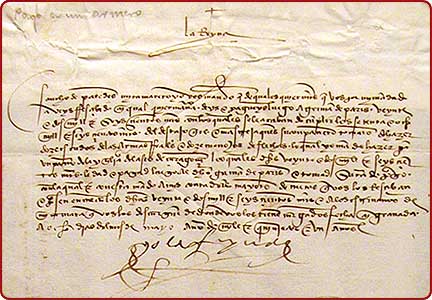
On the bottom half is a signed receipt, in Spanish, dated Granada 8 May 1501, wherein Germán de Paris and Jacques acknowledge receiving the above mentioned payment.
• The usual slash of cancellation (faintly visible above), indicating that this has been entered into the account books. Remnant of stiff paper at top of verso indicating it was once mounted in an album.
 For
our MSS in SPANISH, click here.
For
our MSS in SPANISH, click here.
 This
also appears in the HISPANIC
This
also appears in the HISPANIC

 H.
Estienne's FinalFOLIO
Text
H.
Estienne's FinalFOLIO
Text Greek, Latin, & Impressive
Isocrates. [two
lines in Greek, then] Isocratis Orationes et epistolae cvm Latina interpretatione
Hier. VVolfij, ab ipso postremùm regognita. Henr. Steph. in Isocratem
Diatribæ VII: quarum van obseruationes Harpocrationis in eundem examinat.
Gorgiae et Aristidis quædam, eiusdem cum Isocraticis argumenti. Guil. Cantero
interprete. [Geneva]: Excudebat Henricus Stephanus, 1593. Folio. [fleuron]4*6**4a–z6aa–mm6nn4;
Aa–Ll6; A–C6D4; a
–d
4a.4b.6 (-b.6, blank); [14] ff., 427, [1 (blank)],
131, [1 (blank)], xxxiiii pp., [1 (blank)], [4] ff., 31, [1 (blank)] pp., [9]
ff. (without the final blank).
Greek, Latin, & Impressive
Isocrates. [two
lines in Greek, then] Isocratis Orationes et epistolae cvm Latina interpretatione
Hier. VVolfij, ab ipso postremùm regognita. Henr. Steph. in Isocratem
Diatribæ VII: quarum van obseruationes Harpocrationis in eundem examinat.
Gorgiae et Aristidis quædam, eiusdem cum Isocraticis argumenti. Guil. Cantero
interprete. [Geneva]: Excudebat Henricus Stephanus, 1593. Folio. [fleuron]4*6**4a–z6aa–mm6nn4;
Aa–Ll6; A–C6D4; a
–d
4a.4b.6 (-b.6, blank); [14] ff., 427, [1 (blank)],
131, [1 (blank)], xxxiiii pp., [1 (blank)], [4] ff., 31, [1 (blank)] pp., [9]
ff. (without the final blank).

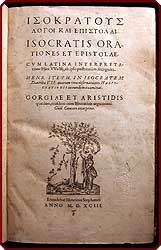

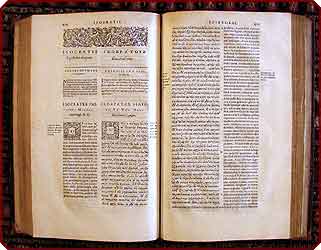
The texts of the orations and "letters" of the great Athenian orator (436–338 B.C.) are printed in double-column format, with the Greek presented in exquisite Greek type in the inner columns and the Latin translation in roman type in the outer ones. A version of the famous Estienne printer's device graces the title-page.
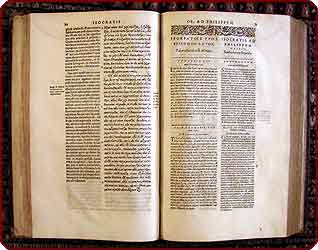
 Single-click either double-page image for an enlargement.
• Adams O219; Renouard (2nd ed.), Annales de l'imprimerie des Estienne, 155.1; Schreiber, Estienne, 225; Schweiger, Handbuch der classischen Bibliographie, I:181; Dibdin (4th ed.), An Introduction to . . . Greek and Latin Classics, II:126. 18th-century plain calf, recently rebacked; round spine, raised bands accented with gilt ruling. Gilt-tooled center devices in spine compartments. Two gilt-lettered spine labels. Title-page dust-soiled; a library's blind pressure-stamps; properly deaccessioned with no additional stamps.  A covetable exemplar.

Contentious Counterpoint — Contemporary Binding Jewel, John. A defence of the apologie of the Churche of Englande conteininge an answeare to a certaine booke lately set foorthe by M. Hardinge, and entituled, A confutation of &c. London: Henry Wykes, 1567. Folio (30.9 cm, 12.1"). [24], 742, [6] pp. (title-page in facsim., pp. 675/76 lacking; pagination erratic).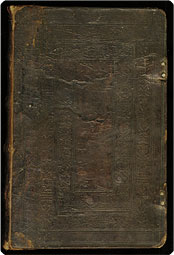
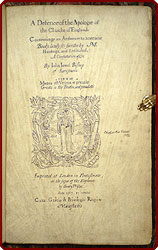
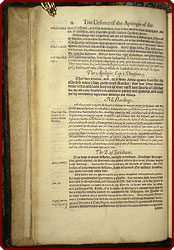
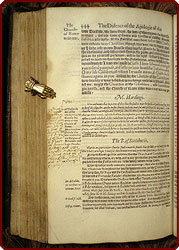 Click the interior images for enlargements.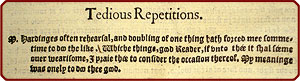
Binding: Contemporary calf over heavy boards, panelled and framed in blind with floral, geometric, and armorial blind-tooling within panels; a pencilled note on the front free endpaper says, “Richardson binding.” There once were clasps, now lost.
Provenance: Title-page with small inked inscription, dated 1836, of Charles Nice Davies (1794–1842), a Welsh linguist, librarian at the Congregational Library, and divinity tutor at Brecon College.
• STC (2nd ed.) 14600.5; ESTC S112182. Bound as above, rebacked preserving original spine; leather cracked, edges and extremities rubbed, clasps now lost, hinges (inside) reinforced some time ago. Institutionally rubber-stamped on lower closed page edges, front pastedown, and first contents page. Title-page provided in early pen and ink facsimile, with inscription as above; last text page with commentary on the book's age, dated 1724 and 1913. Early inked underlining and marks of emphasis throughout; occasional marginalia, two pages dealing with women and the Church having extensive annotations. Pp. 675/76 lacking. One leaf with tear from upper margin extending into three lines of text, without loss; one leaf with large chip from lower margin, not affecting text. Scattered spots of staining only — a clean, strong volume. (24511)

Grynaeus's Edition — Three Maps Justinus, Marcus Junianus; & Pompeius Trogus. Justini ex Trogo Pompeio historia diligentissime nunc quidem supra omnes omnium hactenus aeditiones recognita, et ab innumeris mendis - vetusti exemplaris beneficio purgata. Huic accessit commentariolus. Basilae: apud Michaelem Isingrinium, 1539. Small 4to. [16] ff., 319, [1 (blank)] pp.
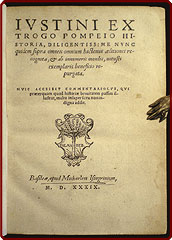
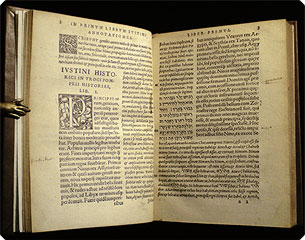 Click the interior images for enlargements.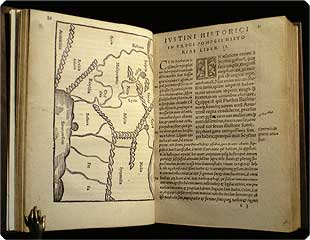
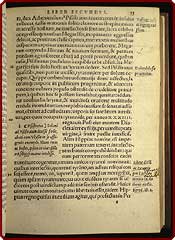
This copy has interesting, early, but now somewhat faded marginalia in a red or sepia ink. The marginalia is scattered and is at times heavy, other times light; in some sections, it is non-existent.
A rare edition: No copy traced via OCLC; VD16 locates only three copies in Europe.
• VD16 T2056. Full rich brown calf old style: Round spine with raised bands, accented in gilt rule; author and title lettered on cream-colored spine label; fillets in blind extending onto covers from each band to terminate in trefoils with blind double fillets beyond. Small rent in upper inner area of title-page with a very old and good repair on verso. Library name stamped on lower edge of closed book. (24808)
 Idols
& Begging
Karlstadt, Andreas. Von Abtuhung der Bylder, und das
Keyn Betdler unther den Christen seyn sollen. [colophon: Wittenberg: Nickell Schyrlentz, 1522].
Small 4to (18.5 cm; 7.25"). [20] ff.
Idols
& Begging
Karlstadt, Andreas. Von Abtuhung der Bylder, und das
Keyn Betdler unther den Christen seyn sollen. [colophon: Wittenberg: Nickell Schyrlentz, 1522].
Small 4to (18.5 cm; 7.25"). [20] ff.
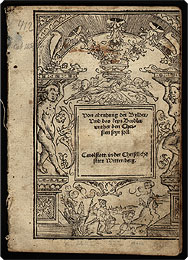
Click the image for an enlargement. The text is printed in gothic type without woodcut initials. The title-page has a woodcut single-element architectural border, this with Abraham and Isaac below the central panel on their way to the sacrificial altar, and with Adam and Eve to the reader's left and right. Putti blow trumpets at mid-center, and above them a device of we're not sure what nature appears to be suspended by decorated cords passing through convenient holes in the vault of the heavens.
WorldCat locates four North American copies, one of which has been deaccessioned, and COPAC locates only two copies (variant title-pages), at the British Library.
• VD16 B6214. Removed from a nonce volume. A copy closely trimmed, costing small portion of left edge of title-page border and one line of text at top of each page of leaf A3; some other leaves also trimmed to take top portions of letters, this impacting (but generally not devastating) reader comprehension; priced accordingly. Otherwise, dust-soiling and stains; some old pencilling and no other markings. (25961)
 His Works & More — A Cut of aScholar ReadingLactantius. Lepida Lactantii Firmiani opera accurate graeco adiuncto castigata: Eiusde[m] Nephytomon: Carmina de Phoenice. & Christi resurrectione. Io. Chry. De eucharistia sermo. Lau. Vall. sermo. Phil. ad Theo. adhortatio. [colophon: Parisiis: Pro Ioha{n}ne Petit fidelissimo bibliopola in Bellouisu, Impressi anno Domini. M.cccccix {1509}]. 4to (19.5 cm; 7.5"). A6 B4 a–z8,4 2A4 2B8 C–N4,8 O6 P4; [10], ccxxxv, [1] ff.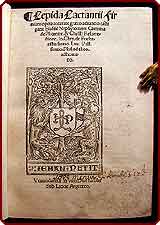
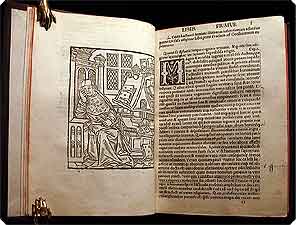 Click either image above for enlargement.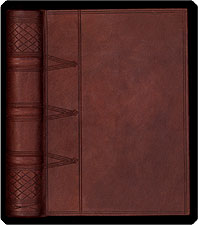
 A 16th-century reader has added a significant amount of marginal commentary on the text.
• Moreau 1509:127; Panzer, VIII, 537, no. 324; Adams L13. Not in Schweiger. Recent calf old style, tooled in blind on spine and covers. Faint traces of water and resultant mild arrested mildew in lower outer corners of earliest few pages. Marginalia in some parts affected by a binder’s trimming; in other cases, not. All edges carmine. A very good copy.
20
Basic Rights for American
IndiansLas Casas, Bartolomé de. Entre los remedios q[ue] do[n] fray Bartolome de las Casas ... refirio ... para reformacio[n] de las Indias. Sevilla: Juan Cromberger, 1552. Small 4to (19.5 cm, 7.5"). a–f8 g6 (-g6, blank); 53 ff. (lacking final blank).
American
IndiansLas Casas, Bartolomé de. Entre los remedios q[ue] do[n] fray Bartolome de las Casas ... refirio ... para reformacio[n] de las Indias. Sevilla: Juan Cromberger, 1552. Small 4to (19.5 cm, 7.5"). a–f8 g6 (-g6, blank); 53 ff. (lacking final blank).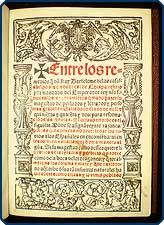
 Las Casas, the first great historian of the New World, arrived in Cuba in 1502 and spent most of the ensuing years in the Caribbean and Mexico until his return to Spain in 1547, so his arguments are based on personal observation and not on Aristotelian theory, as were Sepúlveda’s. He had witnessed first hand the destruction of the American Indian population via the diseases the Spaniards brought with them and through mistreatment and war, things he continually fought against as a priest. After his return to Spain and throughout his old age, he launched a series of attacks on Spanish policy. He engineered the publication of his arguments against Sepúlveda in a series of nine tracts printed in Seville in 1552 and 1553. The first, and most famous, of these tracts was the Brevissima relacion de la destruycion de las Indias, which describes the numerous wrongs inflicted upon the Indians, mainly in the Antilles.
This is first edition of Bartolomé de las Casas's third tract advocating the better treatment of Amerindians by the Spanish. In it he offers 20 detailed suggestions for the better treatment of the natives, including such basics as that they should be secure in their homes. He also flat out calls for the end of the encomienda system and for the placing of all Indians under the direct protection of the crown. All of the tracts are of great significance, both for their immediate effect in reforming the Spanish colonial system to some degree, and as an extremely early example of European concern with the human rights of native people.
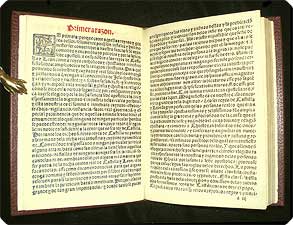
The text is printed in gothic (i.e., “black letter”) as was the custom for “legal” and religious texts. The title-page is printed in red and black, with the text surrounded by a four-panel woodcut border.
Evidence of readership: A half dozen contemporary annotations and textual corrections.
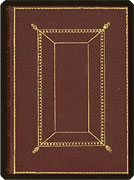
• Alden & Landis, European Americana, 552/9; Sabin 11229; Medina, BHA, 146. Church 89; JCB (3), I, 169; Index Aurel. 132.872; Palau 46942. Full modern deep claret-colored morocco. Round spine with raised bands, each of which is accented above and below by gilt beading. Gilt center devices in blank spine compartments, others with author and title information in gilt lettering. Covers tooled in gilt with rules and rolls forming concentric panels. Gilt corner devices. Marbled endpapers. Minor instances of soiling on title-page, two areas of verso of title-page reinforced. Minor age-toning and soiling, top portion of a few leaves brown-stained. Lower corners of leaves c8 & f4 lacking, restored; nine letters supplied in manuscript facsimile on c8 and four on f4. Lacks final blank leaf. A good copy, untattered.


 TO Part
VI .
. . TO Part
VI .
. . |